
This year shown in yellow, you can see that our initial crop rating was the best of the year and since then we have been dropping down to 67% good to excellent.
That’s about the middle of the path for this time of the year.
This year shown in yellow, you can see that our initial crop rating was the best of the year and since then we have been dropping down to 67% good to excellent.
That’s about the middle of the path for this time of the year.

U.S. winter wheat dropped from 29% to 27% good to excellent with crop conditions lower only one year back in 1989.
Generally, crop conditions did improve in the eastern belt but the larger hard red winter wheat crop in the plains was for the most part lower and that pulled national wheat ratings lower in the weekly update.

Winter wheat did improve from 27% to 29% good to excellent, which is still a very low rating and the lowest since 1996.
With heat and dryness in the southern plains we would expect crop conditions likely to hold about steady heading into next week’s report.
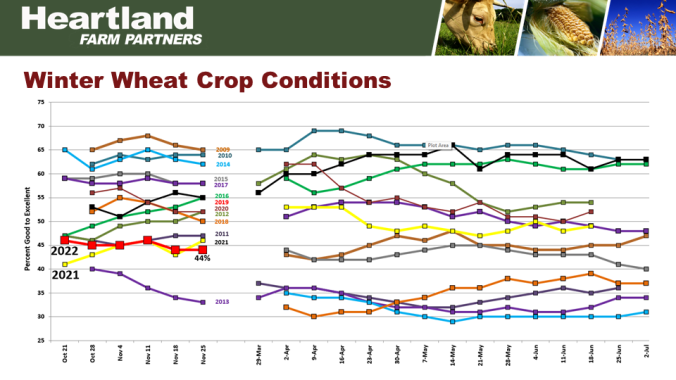
Our winter wheat crop conditions were reported in late November at 44% good to excellent for winter wheat nationwide and then we had the winter dormancy
The USDA will report wheat conditions today nationwide and we should see something coming out around 40% for good to excellent wheat crop conditions.
That would be down from where we came into the Fall dormancy period and would be towards the lower end of crop conditions for this time of year.
We expect to see the lower crop conditions in the west states like Texas, Colorado, Oklahoma, Kansas while conditions should be better in the east like Indiana, Missouri and Illinois.


